Height, spacing, number of pendants, and when a linear fitting makes more sense than individuals. A practical guide to getting kitchen pendant placement right before your electrician visits.
Kitchen pendant placement is one of the questions we get asked most often, and it's worth getting right before work starts. Once ceiling roses are in, adjusting the position is a real cost. This guide covers the key decisions: how high, how far apart, how many, and whether a linear pendant is a better fit for your island than individual pendants.
Height: How Low Should Pendants Hang?
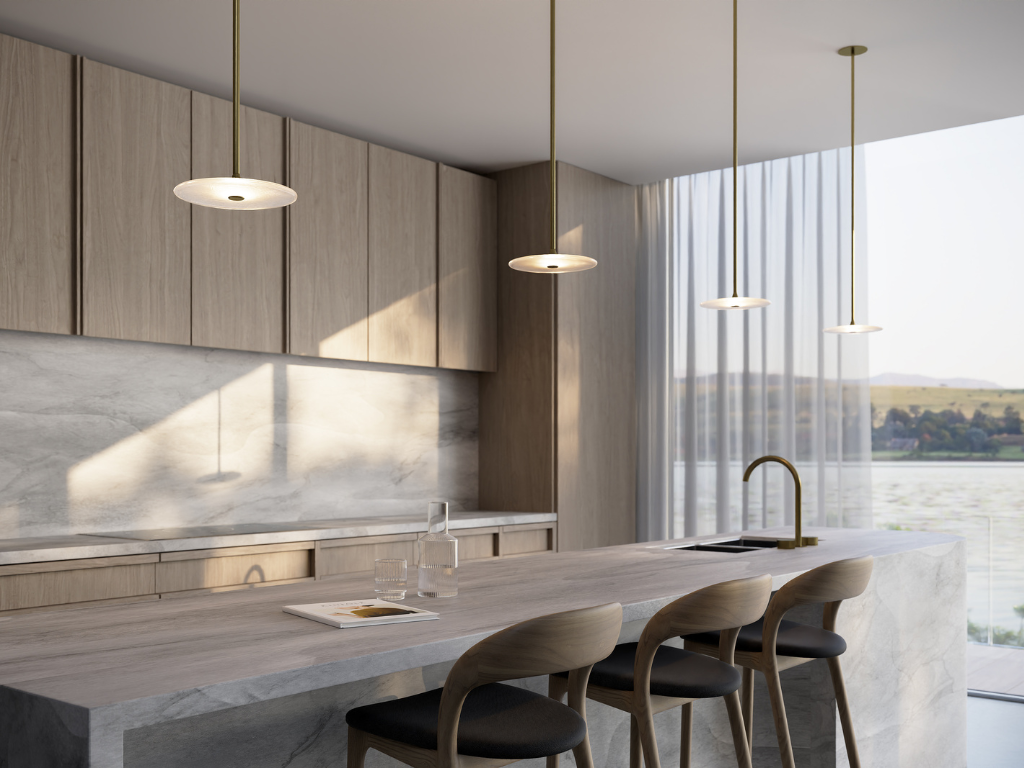
The standard guidance for kitchen pendants over an island or bench is 70 to 90cm from the bottom of the shade to the benchtop surface. This range gives you comfortable task lighting, keeps sightlines clear across the kitchen, and ensures the pendants feel visually anchored to the island rather than floating disconnected from it.
Within that range, the right height depends on two factors: the size of the shade, and your ceiling height. A large shade with significant visual weight generally looks better at the higher end of the range, closer to 80 to 90cm. A smaller, more delicate fitting can sit lower without feeling heavy. For ceilings above 2.7m, you may need to extend the drop slightly to keep the pendant reading as part of the island rather than part of the ceiling.
A useful test: stand at the island and look across it. If the shade interrupts your sightline to the other side of the kitchen, it's hanging too low. If it feels like it belongs to the ceiling rather than the bench, it's too high. The pendant should feel connected to the surface below it.
Spacing: How Far Apart Should Pendants Be?
Pendant spacing is measured centre to centre, from the midpoint of one ceiling rose to the midpoint of the next. A spacing of 70 to 90cm between centres works for most pendant sizes. For larger shades, err toward the wider end of that range to avoid the shades crowding each other. For smaller, more delicate pendants, tighter spacing can work well visually.
Edge clearance matters as much as the spacing between pendants. Leave 15 to 20cm from the end of the island to the centre of the first and last pendant. Any less and the pendants read as cramped at the edges; any more and they look like they've drifted away from the island ends.
If you're using glass shades, allow a minimum of 40cm between the outer edges of adjacent shades. In homes with good airflow, glass pendants can move enough to knock together if spaced too tightly. This is particularly relevant in NZ homes where cross-ventilation is common.
How Many Pendants?
The number of pendants is determined by island length and shade diameter, not by personal preference alone. A rough guide:
| Island length | Pendant count | Notes |
|---|---|---|
| Up to 1.8m | 1 to 2 | One larger shade can work well on a shorter island. Two smaller pendants for a more layered look. |
| 1.8m to 2.4m | 2 | Two pendants is the standard for this range. Space evenly with 15 to 20cm clearance at each end. |
| 2.4m to 3m | 2 to 3 | Depends on shade size. Three smaller pendants or two larger ones. Avoid overcrowding. |
| 3m+ | 3 or linear | Three pendants or a single linear pendant. At this length, a linear often provides a cleaner result. |
When using an odd number of pendants, the centre pendant should align exactly with the midpoint of the island. With an even number, the spacing should be symmetrical from both ends. Either approach works, but asymmetrical placement of any kind will read as a mistake rather than a design choice.
When to Consider a Linear Pendant Instead
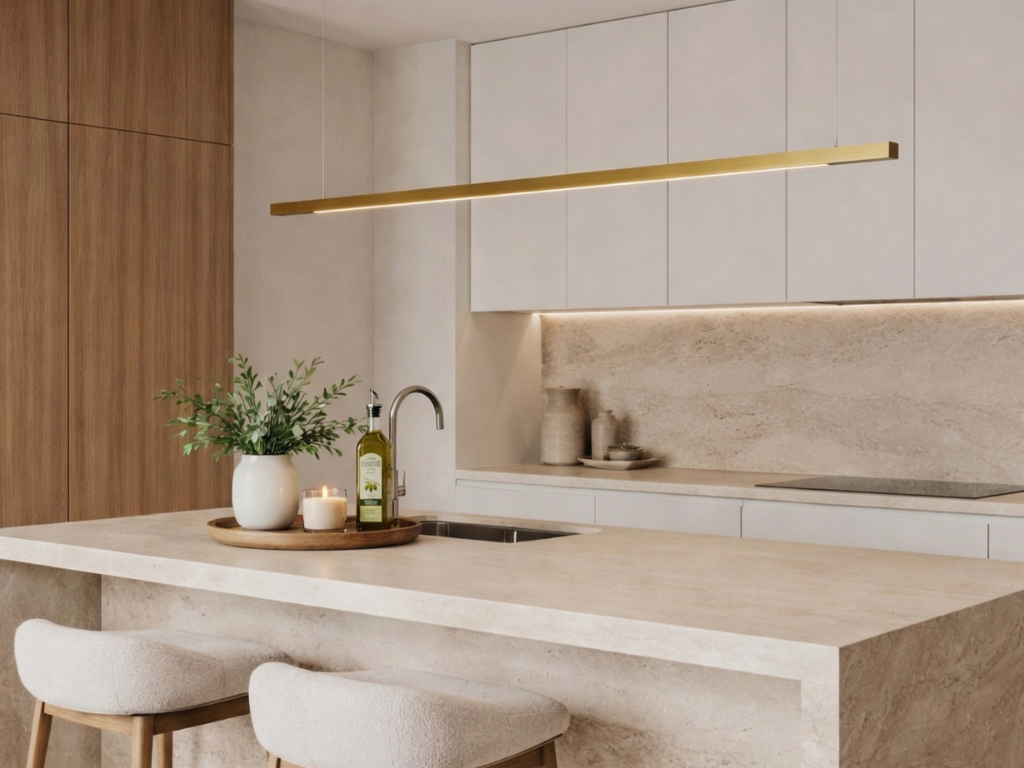
For islands 2.4m and longer, a single linear pendant is often a better solution than two or three individual pendants. The reasons are practical as much as aesthetic.
A linear pendant scaled to the island length provides consistent, even light distribution across the entire surface without the spacing decisions that come with individual pendants. There's no risk of awkward gaps, no chance of uneven placement, and no visual complexity from multiple shades competing for attention. The result is cleaner and generally easier to get right.
- One fitting, one hanging decision, one ceiling rose position
- Even light distribution across the full island length
- Stronger architectural presence than individual pendants at the same scale
- Particularly well suited to minimalist and contemporary kitchens
- Dimmable, allowing the same fitting to serve both task and ambient settings
Our Capsühl Linear is made to order in Cambridge to the exact dimensions of your island. The recommended length is approximately 400mm less than the island, hung at 900mm above the benchtop. Available in Matte Black, Brushed Brass, Natural Oak, Matte White, and Custom Colour.
Browse Capsühl LinearA Note on Ceiling Rose Positioning
Pendant placement starts at the ceiling, not the island. The ceiling rose position determines everything below it, and moving a rose after the ceiling is lined is an expensive job. Before any gib goes up, mark the intended pendant positions on your floor plan and confirm them with your electrician and builder in the same conversation.
The most common mistake is having the ceiling rose positioned over where the island will be, without accounting for the actual centre of the benchtop surface. If your island has an overhang on one side for seating, the pendant should be centred over the benchtop surface, not over the island structure. Confirm the exact island dimensions and overhang measurements before committing to ceiling rose positions.
Not Sure What's Right for Your Kitchen?
Share your island dimensions and ceiling height with the Social Light team and we can advise on pendant count, sizing, and whether a linear is a better fit for your space.
Get in touch Browse pendantsHow high should pendant lights hang over a kitchen island?
The standard guide is 70 to 90cm from the bottom of the pendant shade to the benchtop surface. Larger shades generally look better toward the higher end of that range. For ceilings above 2.7m, extend the drop slightly to keep the pendant visually connected to the island rather than the ceiling.
How far apart should kitchen pendants be spaced?
Space pendants 70 to 90cm apart, measured centre to centre. Leave 15 to 20cm from the end of the island to the centre of the first and last pendant. For glass shades, allow a minimum of 40cm between the outer edges of adjacent shades to prevent them knocking together in breezy conditions.
How many pendant lights do I need over my kitchen island?
For islands up to 1.8m, one to two pendants. For 1.8m to 2.4m, two pendants is standard. For 2.4m to 3m, two or three depending on shade size. For islands 3m and over, three pendants or a single linear pendant. A linear often gives a cleaner result at longer island lengths.
What is the difference between pendant lights and a linear pendant?
Individual pendants are separate fittings hung at intervals, while a linear pendant is a single elongated fitting that spans the length of the island. A linear gives more consistent, even light distribution and removes the spacing decisions that come with individual pendants. It's generally a cleaner solution for islands 2.4m and longer, particularly in minimalist or contemporary kitchens.
When should I decide on pendant placement during a renovation?
Before the ceiling is lined. Ceiling rose positions need to be confirmed with your electrician and builder before gib goes up. Once the ceiling is closed, moving a rose is a costly job. Mark pendant positions on your floor plan early and confirm the exact island dimensions, including any overhang for seating, before committing to ceiling rose locations.